Plan the week you will actually have
First mark when you will eat at home, how many people will be eating and which days leave little cooking time. Every cell does not need a new recipe. Allow for meals out and changed plans.
Then check the refrigerator, freezer and cupboard: what is there, how much remains and what needs using sooner. Inventory comes before the shopping list. Do not return out-of-date or improperly stored food to the plan just to save money.1
Use ingredients across several meals
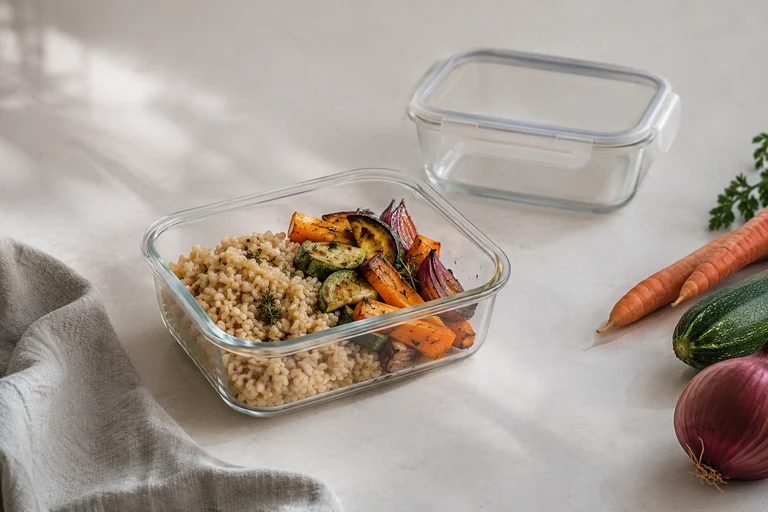
Suppose you have eggs, frozen vegetables and a grain, and need to buy lentils and yogurt. You could make grain with vegetables and lentils, a vegetable omelette, and use yogurt separately or in a sauce. Include these combinations alongside the other meals in your plan.
This uses the same ingredients more than once. If a new recipe requires an unusual ingredient, decide how you will use the rest of it.
- Already available
- Eggs, frozen vegetables and a grain.
- Buy
- Lentils and yogurt in the amount needed.
- Combine
- Grain with vegetables and lentils; omelette; yogurt sauce.
Work out what you need to buy
Add the amount of an ingredient required by the planned dishes, then subtract the usable amount at home. For example, if two recipes need 200 g and 150 g of dry lentils and you have 100 g, you need another 200 + 150 − 100 = 250 g.
Use the same units and preparation state. You cannot subtract 100 g of cooked lentils from a dry-weight requirement as if the amounts were equivalent. Pack sizes determine what you buy; account for any usable stock left over when making the next plan.
- Recipes need
- Total of one ingredient in the same state.
- Already available
- Usable stock in matching units.
- Buy
- Requirement minus existing stock.
- Remaining
- Extra from the pack to account for next time.
A weekly plan is not a week in the fridge
Do not cook everything on Sunday expecting it to keep in the refrigerator until the next Sunday. USDA FSIS advises using properly chilled leftovers within 3-4 days or freezing them for longer storage, with the refrigerator at 40 °F or below; 4 °C is a rounded-down Celsius limit.
Refrigerate promptly in shallow containers. Do not leave food at room temperature longer than two hours, or one hour when the temperature exceeds 90 °F, about 32 °C. Mark the preparation date and plan another cooking session. Follow product-specific instructions and relevant local storage guidance too.2
Record what you cooked and ate
The plan lists future meals, the shopping list covers missing ingredients, and the diary records food already eaten. Do not copy a planned dinner into your diary automatically: its ingredients or portion may have changed.
Use the worksheet for all meals or just dinners. At the end of the week, keep meals that were practical to prepare and replace those you lacked time or ingredients for.
| Day | Meal | Prep | Buy |
|---|---|---|---|
| Mon | |||
| Tue | |||
| Wed | |||
| Thu | |||
| Fri | |||
| Sat | |||
| Sun |