Match the entry to the food state
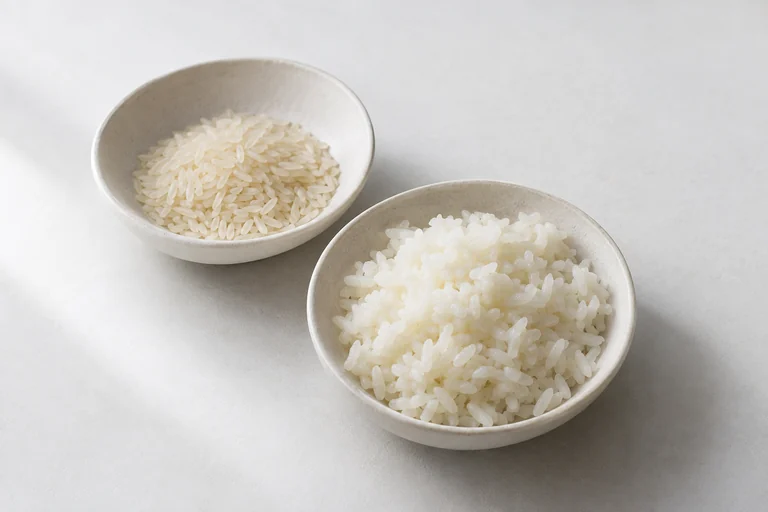
Dry grain and cooked grain are different entries by weight. Boiling may add water; baking may remove it. Meat can lose both moisture and fat. Do not select “cooked rice” and multiply its values by the dry ingredient weight.
Choose one consistent route: calculate your recipe from its ingredients and weigh the finished yield, or use an appropriate cooked-food entry for an already cooked portion. The ingredient route is usually more practical for a homemade mixed dish.12
Record the ingredients that went into the dish
Weigh the edible ingredients and include oil, sauces and other additions. Divide the amount used for the whole pan between portions; do not assign it to every portion.
If you discard fat, marinade or cooking liquid, the ingredient total will not tell you exactly what remains. Record what was removed and how the dish was prepared. There is no single loss percentage that applies to every recipe.2
Calculate the whole recipe
For an illustrative calculation, take: 200 g dry grain at 350 kcal per 100 g; 300 g vegetables at 30 kcal; and 10 g oil at 900 kcal. Their contributions are 700 + 90 + 90 = 880 kcal. That is for the whole recipe, not per 100 g.
If the grain has 7 g protein, 1 g fat and 78 g carbohydrate per 100 g, the vegetables 1/0/6 g and the oil 0/100/0 g, the recipe totals 17 g protein, 12 g fat and 174 g carbohydrate. For example, protein is 7 × 2 + 1 × 3 = 17 g. Do not force energy to agree to the last digit with a macro calculation: the starting records and labels may be rounded.
- Grain, 200 g
- 350 × 200 / 100 = 700 kcal.
- Vegetables, 300 g
- 30 × 300 / 100 = 90 kcal.
- Oil, 10 g
- 900 × 10 / 100 = 90 kcal.
- Whole dish
- 700 + 90 + 90 = 880 kcal.
Weigh the finished yield and your portion
Weigh the finished food without its container. At a 1,000 g yield, the recipe contains 880 / 1,000 × 100 = 88 kcal per 100 g. A 250 g portion is one quarter: 220 kcal, 4.25 g protein, 3 g fat and 43.5 g carbohydrate using these totals.
If the same calculated ingredients finish at 900 g, the concentration rises to about 97.8 kcal per 100 g. The same calorie total is now divided by a smaller finished weight. Portion calculation is simply: recipe total × portion weight / finished yield.1
Keep the ingredients and finished weight
Check ingredients and finished yield each time you repeat the recipe. A different brand, oil amount or water loss changes the estimate. A household record makes calculations repeatable, but does not measure every nutrient change caused by heat.3
- Ingredients
- Name, state, weight and source of nutrition values.
- Preparation
- Anything added, removed or drained.
- Finished yield
- Food weight without the container.
- Portion
- Amount actually eaten and its share of the yield.