For education. Use a qualified healthcare professional for diagnosis and treatment decisions. How we use sources.
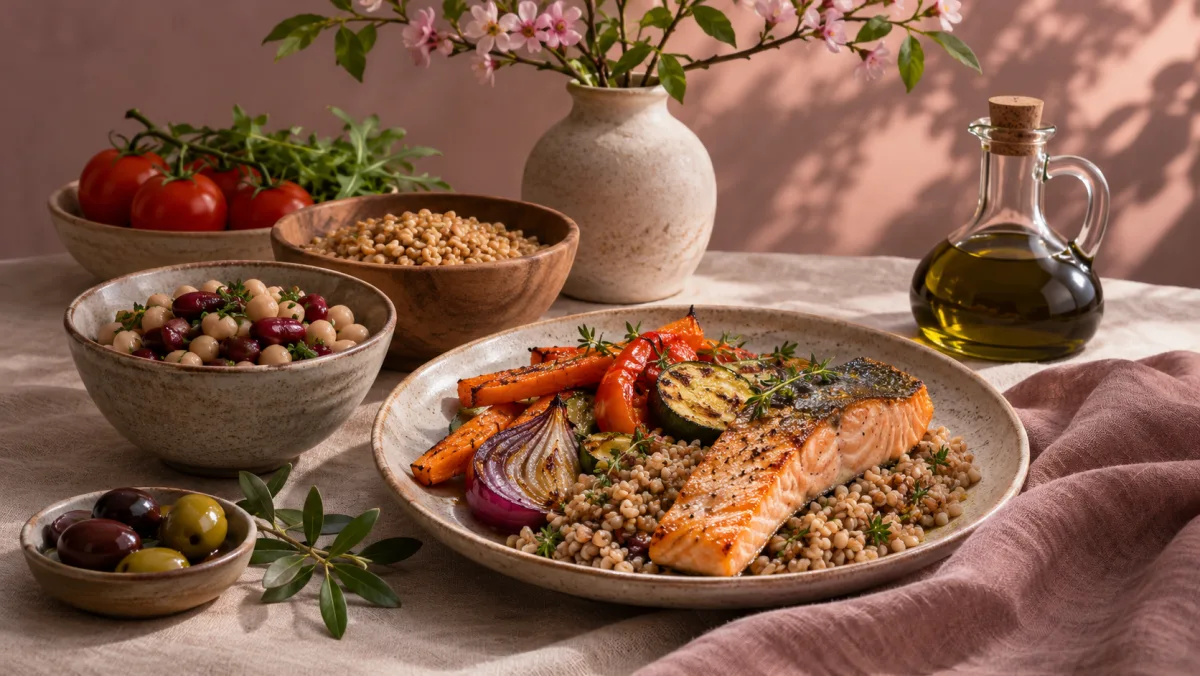
The Mediterranean diet is about proportions, not Italian products: plenty of vegetables, fruit, legumes, and whole grains; nuts; vegetable oil as the main fat; fish more often than meat; and moderate dairy. These food groups are available in an ordinary Russian grocery store: lentils, buckwheat, cabbage, herring, walnuts, and rapeseed oil. But substituting foods is an extrapolation: studies used olive oil and nuts, not rapeseed oil and pearl barley. Below are substitution tables with figures and a three-day menu.
What matters most
A Cochrane review defined the diet using two required conditions: a high ratio of monounsaturated to saturated fats (olive oil as the main fat, or other foods with monounsaturated fats such as nuts) and plenty of plant foods, including fruit, vegetables, and legumes. Additional features include whole grains, little meat and processed meat, more fish, moderate dairy, and a small amount of red wine 1. The wording matters: the fat ratio is central, while the specific oil is secondary. Wine appears as an additional feature; there is no need to start drinking for the diet.
What is known about benefits, and what is not
The major PREDIMED study took place in Spain: 7,447 people aged 55–80 at high cardiovascular risk, with a median follow-up of 4.8 years. Results were published in 2013, then retracted because of randomization irregularities (including at one of 11 centers), and republished in 2018 with a recalculated analysis. A major cardiovascular event occurred in 3.8% of participants in the olive-oil group, 3.4% in the nut group, and 4.4% in the control group; hazard ratios were 0.69 and 0.72 2. The control group received advice to reduce fat, not to continue its usual diet.
The 2019 Cochrane review (30 studies, 12,461 people) was more cautious. For primary prevention, it says PREDIMED found little or no change in cardiovascular or overall mortality (low-certainty evidence), while the number of strokes decreased (risk ratio 0.60, moderate-certainty evidence); blood pressure was slightly lower on average. Evidence for secondary prevention was sparse, and the authors acknowledge continuing uncertainty 1. This is a reasonable eating pattern, not a treatment, and results cannot be assumed to apply to everyone.
Which oil to use instead of olive oil
You can check the review's criterion using a number: the ratio of monounsaturated to saturated fats. USDA FoodData Central (SR Legacy, per 100 g) gives these values for oils 3:
| Oil (database entry) | Saturated, g | Monounsaturated, g | Polyunsaturated, g | MUFA/SFA ratio |
|---|---|---|---|---|
| Olive | 13.8 | 73.0 | 10.5 | 5.3 |
| Rapeseed (listed as “canola”) | 7.4 | 63.3 | 28.1 | 8.6 |
| Regular sunflower, about 65% linoleic | 10.3 | 19.5 | 65.7 | 1.9 |
| High-oleic sunflower | 9.9 | 83.7 | 3.8 | 8.5 |
The surprising result is that rapeseed oil is at least as good as olive oil by this criterion, while regular sunflower oil is notably less favorable: it has less monounsaturated fat than polyunsaturated fat. The database does not distinguish unrefined and refined oil or your specific bottles, so check the label. Equivalence in health outcomes has not been established. The study closest to rapeseed oil was the Lyon Diet Heart Study: 605 people with heart disease received Mediterranean-style advice and rapeseed-oil margarine. The review rated the evidence low certainty and noted reduced mortality 1.
Substitution chart
These are substitutions by composition, not by health outcomes. All values per 100 g come from the same database 3; your package may differ.
| Mediterranean food | Local substitute | What changes |
|---|---|---|
| Olive oil | Rapeseed or high-oleic sunflower oil | See table above; all oils have the same energy, 884 kcal |
| Salmon, sardines | Herring, mackerel, canned sardines | EPA + DHA, g: farmed salmon 2.0, herring 1.6, mackerel 2.3, canned sardines 1.0; sodium in canned sardines 307 mg, pickled herring 870 mg |
| Feta | Brynza, Adyghe cheese | Database has feta only: 1,139 mg sodium, about 2.8 g salt; check labels for brynza and Adyghe cheese |
| Chickpeas | Peas, beans, lentils | Fiber, g, cooked: chickpeas 7.6, lentils 7.9, split peas 8.3, white beans 6.3; differences are small |
| Bulgur | Buckwheat, pearl barley | Cooked: bulgur 83 kcal and 4.5 g fiber, buckwheat 92 and 2.7, pearl barley 123 and 3.8 |
| Arugula, spinach | White or sauerkraut, beets, carrots | Fiber, g, raw: arugula 1.6, spinach 2.2, cabbage 2.5, beet 2.8; sauerkraut has 661 mg sodium, about 1.7 g salt |
| Almonds | Walnuts, seeds | Almonds: 579 kcal, more monounsaturated fat (31.6 g); walnuts: 654 kcal, more polyunsaturated fat (47.2 g) |
The Nordic diet is often mentioned as a model built around rapeseed oil and local foods. In Sweden's NORDIET study, 88 people with moderately high cholesterol followed it for six weeks, receiving all their food; compared with the control group, LDL fell by 21% 4. The study was short and examined the whole diet, not a single food.
How much of each food per week
There is no single standard, and sources give different amounts. This article uses an official US document: the 2020–2025 Dietary Guidelines for Americans (USDA and HHS) includes a “Healthy Mediterranean-Style Dietary Pattern” with amounts by food group for different calorie levels 5. The table below uses 2,000 kcal per day. Units are US measures; the gram conversions are the author's. One serving from the protein group is 28 g lean meat, poultry, or fish, one egg, or 14 g nuts; a cup means a cup of raw or cooked vegetables or fruit.
| Food group | Amount for 2,000 kcal | Conversion |
|---|---|---|
| Vegetables | 2½ cups per day | |
| Legumes (peas, beans, lentils) | 1½ cups per week | |
| Fruit | 2½ cups per day | |
| Whole grains | 3 servings per day out of 6 grain servings | 1 slice bread or ½ cup cooked grain per serving |
| Fish and seafood | 15 servings per week | About 425 g cooked |
| Nuts, seeds, soy products | 5 servings per week | About 70 g nuts |
| Meat, poultry, eggs | 26 servings per week | About 735 g |
| Dairy | 2 cups per day | |
| Oils | 27 g per day | About 2 tablespoons |
The guide's 27 g of oil a day is about two tablespoons at 13.5 g each and, according to USDA, about 240 kcal (27 × 8.84). The guidance reminds readers that nuts, seeds, and fish also naturally contain oils, so how much to pour on a salad depends on the rest of the day. See A handful of nuts in grams and pieces: which to choose for more on nuts. WHO recommends less than 5 g salt per day 6; How much salt per day, and where it hides beyond the salt shaker explains how to count it.
A three-day menu from an ordinary grocery store
Calculations use USDA SR Legacy entries 3. Oats, carrots, onion, and cabbage are weighed raw; legumes, buckwheat, and potatoes are cooked. No salt was added; rapeseed oil was used; tvorog uses the US entry for 2% cottage cheese. This illustrates the composition of a menu and does not set your personal needs: calorie intake depends on height, weight, and activity.
Day 1. Breakfast: 70 g dry rolled oats cooked in water, apple 150 g, walnuts 20 g. Lunch: lentil soup (cooked lentils 250 g, carrot 60 g, onion 50 g, oil 10 g), rye bread 80 g. Snack: tvorog 150 g and apple 150 g. Dinner: baked herring 100 g, boiled potatoes 250 g, sauerkraut 100 g, oil 10 g. Total: about 1,830 kcal, protein 87 g, fat 57 g, carbohydrates 252 g, fiber 50 g, salt from foods about 4.5 g (including 1.65 g from sauerkraut and 1.2 g from bread).
Day 2. Breakfast: tvorog 150 g, frozen blueberries 100 g, seeds 20 g, rye bread 40 g. Lunch: salad with cooked beet 150 g and white beans 200 g, oil 10 g, walnuts 20 g, bread 80 g. Dinner: buckwheat 250 g, stewed cabbage 200 g, carrot 50 g, and onion 50 g cooked with oil 15 g, two hard-boiled eggs. Total: about 1,770 kcal, protein 80 g, fat 70 g, carbohydrates 221 g, fiber 42 g, salt from foods about 3.8 g.
Day 3. Breakfast: rolled oats 70 g, frozen blueberries 100 g, seeds 15 g. Lunch: pea soup (cooked split peas 250 g, carrot 60 g, onion 50 g, oil 10 g), bread 80 g. Snack: apple 150 g and walnuts 15 g. Dinner: canned sardines 80 g, potatoes 200 g, cabbage salad 150 g and carrot 50 g with oil 15 g. Total: about 1,740 kcal, protein 70 g, fat 61 g, carbohydrates 241 g, fiber 52 g, salt from foods about 2.1 g.
This menu contains a lot of fiber; if you are not used to legumes, add them gradually. You can save the dishes in Nuteva as your own recipes to make it easier to assemble a week and check nutrition. A notebook table does the same.
For weight loss and health conditions
For weight loss, total calorie balance matters. Olive and rapeseed oils have the same calories: 884 kcal per 100 g, or about 120 kcal per tablespoon; three tablespoons a day are about 360 kcal. See Cooking oils by the spoonful: calories, composition, and heating for an oil comparison. How to plan a week's meals has ideas for a weekly plan.
If you have high cholesterol, fatty liver disease, diabetes, or another condition, discuss a Mediterranean-style pattern with a clinician; an article cannot prescribe a diet. Questions for an appointment:
- Ask whether this eating pattern fits your lipid results (see How to read a lipid panel).
- Ask how much vegetable oil and how many nuts fit your calorie needs.
- Ask whether you need to limit salt or legumes because of medications or health conditions.
Sources
- Rees K. et al., Mediterranean-style diet for the primary and secondary prevention of cardiovascular disease, Cochrane Database Syst Rev 2019. Review definition, 30 studies, 12,461 participants; low- and moderate-certainty evidence for clinical outcomes.
- Estruch R. et al., Primary prevention of cardiovascular disease with a Mediterranean diet supplemented with extra-virgin olive oil or nuts, N Engl J Med 2018. Republished PREDIMED study: people aged 55–80 at high cardiovascular risk, Spain; control received advice to reduce fat.
- USDA FoodData Central: SR Legacy (2018 dataset). Composition of oils, fish, legumes, grains, vegetables, nuts, cheese, and menu foods; average entries in a US database, package values differ.
- Adamsson V. et al., Effects of a healthy Nordic diet on cardiovascular risk factors in hypercholesterolaemic subjects (NORDIET), J Intern Med 2011. 88 people with moderately elevated cholesterol, Sweden, six weeks, all food provided; short whole-diet study.
- USDA and HHS: Dietary Guidelines for Americans 2020–2025, Appendix 3, Table A3-5 (Healthy Mediterranean-Style Dietary Pattern). Food-group amounts for a 2,000-kcal level and serving definitions; US public-health guidance, not a Russian document.
- WHO: Healthy diet. Less than 5 g salt per day for adults; general recommendations.