For education. Use a qualified healthcare professional for diagnosis and treatment decisions. How we use sources.
Iron from meat and fish (heme iron) is absorbed better than iron from plants (nonheme iron). What else is on the plate affects nonheme absorption: vitamin C and meat help, while tea, coffee, and phytates in grains and legumes hinder it. There is a caveat: studies of a single meal show large effects, while the effects are considerably smaller in an ordinary diet of many meals. If you suspect iron deficiency, start with testing and a clinician; the menu can wait.
Two forms of iron and one inconvenient number
Plants and fortified foods contain only nonheme iron. Meat, fish, and poultry contain both forms. Heme iron provides about 10–15% of total iron intake in Western countries; the rest is nonheme. 1
Absorption differs. Estimates for people without depleted iron stores are 14–18% from a mixed diet containing meat and 5–12% from a vegetarian diet. 2 Therefore, US recommended dietary allowances (RDA) for vegetarians are 1.8 times higher than for others. 1 Russian recommendations MR 2.3.1.0253-21 do not provide a separate vegetarian adjustment. 3
Spinach, which often tops lists of “iron-rich foods,” is a good example of the trap. It contains iron, but NIH classifies it among plants with low iron bioavailability and cites polyphenols as a reason. 1
How much iron do Russian and US guidelines recommend?
Russian methodological recommendations MR 2.3.1.0253-21 give adults over 18 a daily reference of 10 mg for men and 18 mg for women. 3 US recommendations are 8 mg for men, 18 mg for women aged 19–50, and 8 mg after age 51. 1 Women with heavy periods are at higher risk of iron deficiency. 1 Pregnancy and breastfeeding needs are not covered here; discuss them with a clinician.
Iron per serving: what a plate provides
The table is compiled from the NIH summary, with values from USDA FoodData Central. Serving sizes are US measures; values are rounded to whole milligrams. Your package may differ, so check its label. 1
| Food | Serving | Iron, mg | Form |
|---|---|---|---|
| Cereal fortified with 100% of the US daily value | 1 labeled serving | 18 | Nonheme |
| Canned white beans | 1 cup (about 240 ml) | 8 | Nonheme |
| Pan-fried beef liver | 85 g (3 oz) | 5 | Heme and nonheme |
| Cooked lentils | ½ cup | 3 | Nonheme |
| Cooked spinach | ½ cup | 3 | Nonheme; poorly absorbed |
| Firm tofu | ½ cup | 3 | Nonheme |
| Dark chocolate, 45–69% cocoa | 28 g (1 oz) | 2 | Nonheme |
| Cooked chickpeas | ½ cup | 2 | Nonheme |
| Sardines in oil with bones | 85 g | 2 | Heme and nonheme |
| Lean stewed beef | 85 g | 2 | Heme and nonheme |
| Cashews | 28 g (about 18 nuts) | 2 | Nonheme |
| Roasted chicken | 85 g | 1 | Heme and nonheme |
| Whole-wheat bread | 1 slice | 1 | Nonheme |
| Milk | 1 cup | 0 | None |
Notice that 85 g beef and ½ cup chickpeas each provide 2 mg. But some iron in meat is heme, and meat also improves absorption of nonheme iron from nearby foods. 1 The table shows iron content; how much reaches the bloodstream depends on what else is on the plate.
What helps or hinders absorption on your plate
The clearest results come from experiments using radioactively labeled iron, where the same meal was served with different drinks.
| Combination | Study result | How to use it |
|---|---|---|
| Orange juice with a meal | Nonheme iron absorption from lunch rose 85% 4 | Have juice or a fresh vitamin-C-rich vegetable with the same meal as legumes |
| Tea with a meal | Absorption fell 62% 4 | Have tea between meals, not with food 5 |
| Coffee with a meal | Fell 35% 4; another study found 39% versus 64% for tea 6 | Do not use it to wash down an iron-containing meal |
| Milk and beer | No significant effect found 4 | NHS still advises reducing dairy with deficiency 7; sources differ |
| Phytates and polyphenols in grains and legumes | Reduce nonheme iron absorption 1 | Do not eliminate whole grains; pair them with vitamin C sources |
| Calcium | May reduce absorption of both heme and nonheme iron, but the effect is not conclusive 1 | No special rules for healthy people; discuss with a clinician if deficient |
The familiar advice to “drink tea an hour after a meal” is less well supported than it sounds. In a study of timing, coffee an hour before a meal did not reduce absorption, while coffee an hour after inhibited iron just as much as coffee with the meal. 6 The timing was studied for coffee and in people without iron deficiency. A tea review recommends drinking it “between meals” and pairing it with vitamin C or meat, fish, or poultry. 5
In multi-day studies of ordinary diets, where enhancers and inhibitors act together, the effect of any one food is much smaller; a person’s iron stores matter more than diet composition. 2 NIH notes that these effects are blunted in a typical Western diet and make little difference to iron status for most people. 1 Vitamin C helps absorption in the meal in which it is consumed: in an older experiment, a large dose at breakfast did not affect iron from lunch or dinner, and the relative increase was smaller with meat than in a meat-free meal. 8 Thoughtful combinations matter most for meals with no meat and for people at risk of deficiency; the tea review directs its advice to these groups. 5
Three plates, calculated from the table
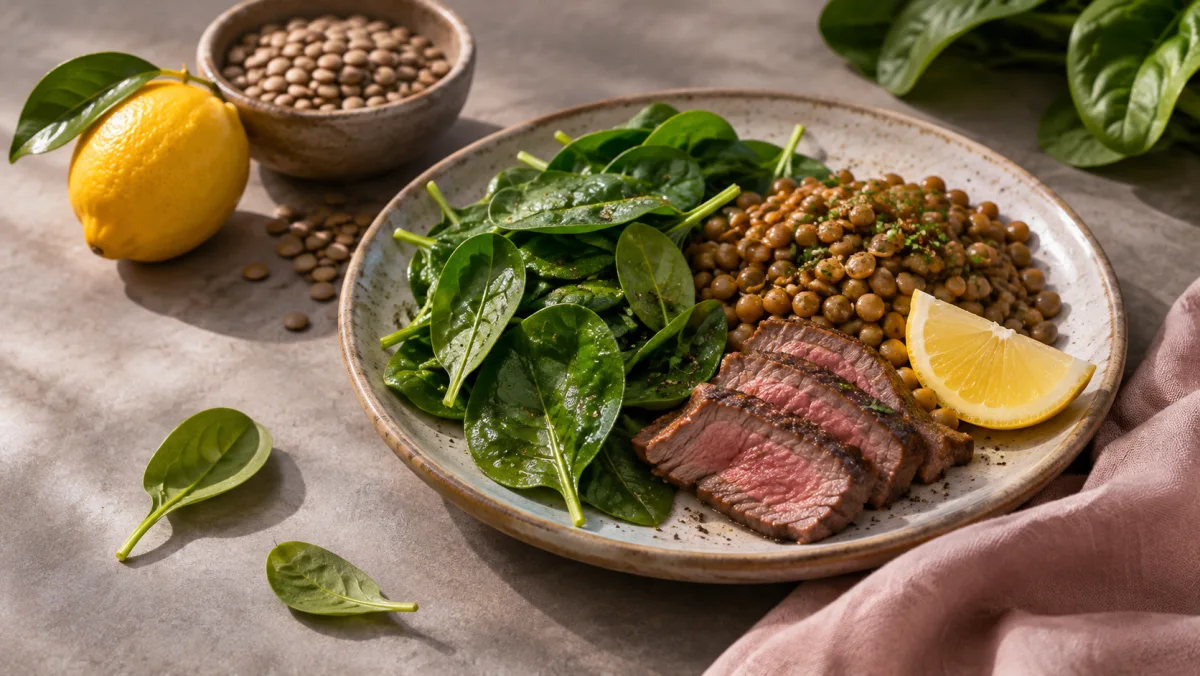
Eats everything except liver. 85 g stewed beef (2 mg), ½ cup lentils (3 mg), raw vegetables, and an orange for dessert. Total: 5 mg, or about 28% of 18 mg (the Russian and US reference for women of childbearing age). Meat in the meal helps absorb iron from lentils. Save tea for between meals.
Does not eat meat. ½ cup lentils (3 mg), ½ cup tofu (3 mg), a slice of whole-wheat bread (1 mg), and pepper or citrus in a salad. Total: 7 mg. Applying the US 1.8 adjustment to this diet, these 7 mg are roughly equivalent to 3.9 mg for someone who eats meat. Vegetarians may want to pay closer attention to fortified foods: the cereal in the table has 18 mg, but it is a US product; check the ingredients on products sold locally.
Avoids both liver and red meat. 85 g sardines (2 mg), ½ cup chickpeas (2 mg), and a handful of cashews (2 mg). That is 6 mg without meat or poultry. Have juice rather than tea with this meal: in the hamburger, green-bean, and mashed-potato meal study, it raised nonheme absorption by 85%.
If you like a combination, such as lentils with vegetables and herbs, save it as your recipe in Nuteva so it can become a regular meal without having to remember the proportions.
When food is not enough: testing and a clinician
Iron deficiency cannot be diagnosed from a menu or fatigue. NHS lists tiredness, shortness of breath, palpitations, and paleness as symptoms of iron-deficiency anemia, but they can have other causes too; a clinician often starts with a complete blood count. 7 NIH adds that hemoglobin and hematocrit are not very sensitive or specific screening measures, so ferritin is often added. 1 See “What Ferritin Shows” and “Low Serum Iron: What It Means” for interpreting these measures.
Deficiency is not always caused by diet. According to NHS, common causes include heavy periods and blood loss in the stomach or intestines, such as from an ulcer or pain medicines like ibuprofen and aspirin. 7 If anemia is found, a clinician should investigate the cause; diet alone cannot identify it.
Do not take iron supplements without medical advice. The risk of iron overload from ordinary food is low in adults with normal intestinal function, while high supplement doses can cause nausea and constipation, and very high doses can have serious consequences. 1 Keep iron tablets away from children: overdose in a young child can be fatal. 7
Questions for your clinician:
- Which tests can assess iron stores beyond hemoglobin?
- If iron is low, should we look for a cause?
- How should diet fit with any treatment prescribed?
- When should I repeat the test?
Have tea later; put the meal on paper
If you eat meat and fish and your tests are normal, there is little reason to change habits just for iron: in a typical mixed diet, these combinations have little effect on iron stores. 1 If you do not eat meat or a clinician has found a deficiency, look at what you drink with your main meal containing legumes or grains. Move tea or coffee to a break between meals and have juice or a fresh vegetable alongside the meal. Write down three or four foods from the table that you already eat, with serving sizes; add them up to see what your daily iron intake actually consists of.
Sources
- NIH Office of Dietary Supplements: Iron, Fact Sheet for Health Professionals. Iron forms, absorption, US RDA, USDA FoodData Central iron table, risk groups, and supplements. US servings and recommendations; page updated September 4, 2025.
- PubMed: Hurrell R., Egli I., Iron bioavailability and dietary reference values, Am J Clin Nutr, 2010. Absorption estimates of 14–18% and 5–12%, and finding that individual factors have modest effects in multi-day studies.
- Rospotrebnadzor: MR 2.3.1.0253-21, Norms of physiological requirements for energy and nutrients. Adult iron references (Tables 12 and 17). Text reproduced on legalacts.ru; no separate vegetarian adjustment.
- PubMed: Hallberg L., Rossander L., Effect of different drinks on the absorption of non-heme iron from composite meals, Hum Nutr Appl Nutr, 1982. Effect of tea, coffee, orange juice, milk, and beer on nonheme absorption. One standard meal (hamburger, green beans, mashed potatoes).
- PubMed: Zijp I.M. et al., Effect of tea and other dietary factors on iron absorption, Crit Rev Food Sci Nutr, 2000. Review of tea and recommendation to drink it between meals. An author was affiliated with Unilever.
- PubMed: Morck T.A., Lynch S.R., Cook J.D., Inhibition of food iron absorption by coffee, Am J Clin Nutr, 1983. Coffee and tea with meals, coffee an hour before and after. Participants did not have iron deficiency.
- NHS: Iron deficiency anaemia. Symptoms, causes, diagnosis, and supplements. UK general guidance.
- PubMed: Cook J.D., Monsen E.R., Vitamin C, the common cold, and iron absorption, Am J Clin Nutr, 1977. Vitamin C increases iron absorption in the same meal; effect smaller when meat is included. Experiments in men.