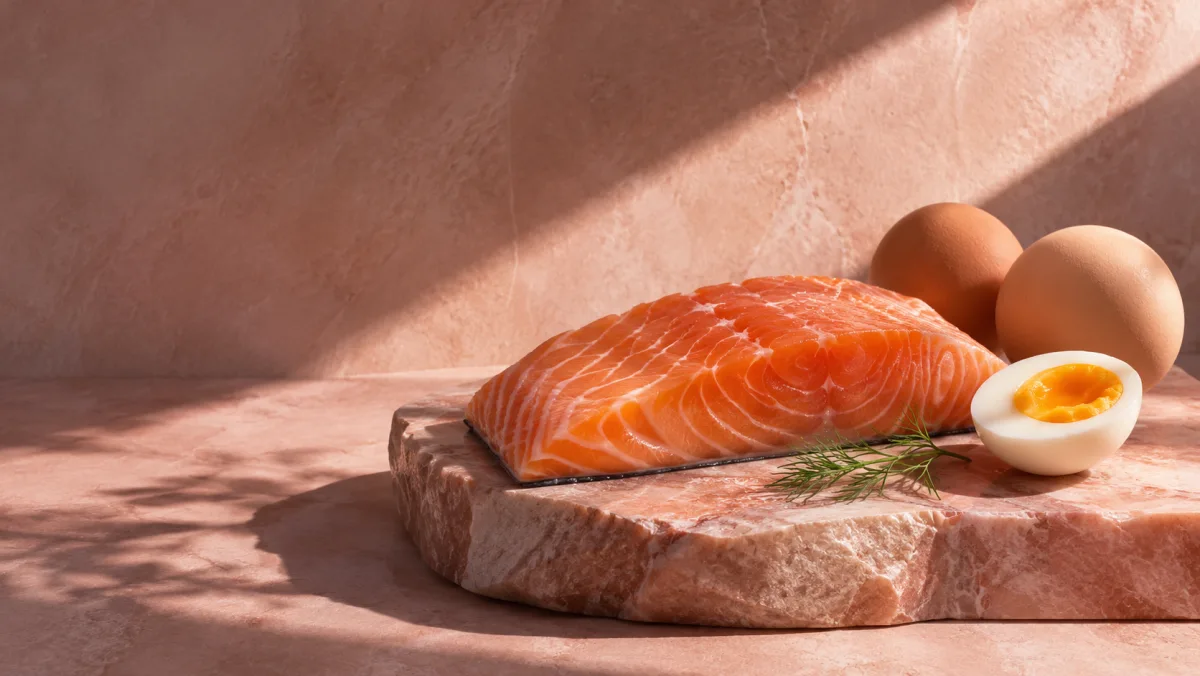
For education. Use a qualified healthcare professional for diagnosis and treatment decisions. How we use sources.
It is difficult to get enough vitamin D from food alone: substantial amounts are found mainly in fatty fish, while an egg has about 1 mcg against a reference of 15 mcg. Sunlight helps skin make vitamin D, but in a 1988 experiment, skin did not produce even its precursor on clear days in Edmonton from October through March (or in Boston from November through February). Moscow and St. Petersburg are farther north than Edmonton. A clinician decides whether a supplement is needed, sometimes based on a blood test.
Three reference amounts and one unit conversion
Russian methodological recommendations MR 2.3.1.0253-21 give adults 15 mcg vitamin D a day and people over 65 20 mcg. 1 The US RDA for adults aged 19–70 is also 15 mcg, or 600 IU; after age 70 it is 20 mcg, or 800 IU. 2 NHS gives 10 mcg for adults. 3
Convert units this way: 1 mcg equals 40 IU, so 10 mcg is 400 IU. 3 Confusing mcg and IU creates a 40-fold error, so check which unit the label uses.
Vitamin D helps the body absorb calcium; if dietary calcium is low or vitamin D is low, bone formation is affected. 2 Other claimed benefits have been studied less conclusively. In the large VITAL trial of 25,871 participants (US men aged 50+ and women aged 55+), daily vitamin D3 did not lower cancer or cardiovascular event rates over a median 5.3 years: hazard ratio 0.96 (confidence interval 0.88–1.06) for cancer and 0.97 (0.85–1.12) for cardiovascular events. 4 This does not mean supplements are unnecessary for a confirmed deficiency: the trial asked a different question.
How much vitamin D is in a serving?
Values below come from the USDA vitamin D list (SR Legacy, 2018), reported in IU per household measure. They are converted to mcg and compared with the Russian reference of 15 mcg (600 IU). Servings and fish varieties are US-based and may differ from products sold locally; a specific product will vary. 5
| Food | Serving | IU | mcg | Share of 15 mcg |
|---|---|---|---|---|
| Farmed rainbow trout, baked or grilled | 1 fillet | 539 | 13.5 | 90% |
| Canned pink salmon, drained | 85 g (3 oz) | 493 | 12.3 | 82% |
| Raw Spanish mackerel | 85 g | 248 | 6.2 | 41% |
| Baked or grilled flounder or sole | 1 fillet | 177 | 4.4 | 30% |
| Pickled Atlantic herring | 1 cup | 158 | 4.0 | 26% |
| Raw chanterelle mushrooms | 1 cup | 114 | 2.9 | 19% |
| Calcium- and vitamin-D-fortified orange juice (US) | 1 cup | 100 | 2.5 | 17% |
| Fortified fat-free milk (US) | 1 cup | 98 | 2.5 | 16% |
| Chicken egg | 1 large | 41 | 1.0 | 7% |
| Canned Atlantic cod | 85 g | 40 | 1.0 | 7% |
Check the math: 493 IU divided by 40 equals 12.3 mcg; divided by 600, it is 82%. An egg, often called a source of vitamin D, provides only 7% of the reference; it would take twelve eggs to match a serving of canned pink salmon.
Now estimate a week with fish “twice a week.” Two 85 g servings of pink salmon provide 986 IU, or an average of 141 IU a day—about 23% of 600 IU. Three servings a week provide about 35%. Fish helps considerably, but the rest has to come from other sources.
If you plan to eat fish twice a week, save your usual fish and canned varieties as foods in Nuteva, making them easier to add to meals and log.
Sunlight: why latitude and season matter
Vitamin D forms in skin under UVB light. A 1988 study measured whether this was possible in different months. On clear days in Boston (42.2° N), even the precursor to vitamin D3 did not form in sunlight from November through February. In Edmonton (52° N), this ineffective period lasted from October through March. At 34° and 18° N, synthesis continued even in midwinter. 6 The authors call this “vitamin D winter,” which lengthens with latitude.
The study did not include Russian cities, so the table below extrapolates from two locations (the author’s guide, not a research finding). City latitudes are rounded, and cloud cover is not accounted for.
| City | Approx. latitude | Closest study location | Period without synthesis |
|---|---|---|---|
| Sochi | 44° | Boston, 42° | At least November–February |
| Moscow | 56° | Edmonton, 52° | At least October–March |
| St. Petersburg | 60° | North of Edmonton | Considerably longer |
| Murmansk | 69° | North of Edmonton | Considerably longer |
This is consistent with UK data: NHS says most people can get what they need from sunlight from late March or early April to the end of September, with insufficient production from October to early March. 3 How much skin produces varies greatly. It produces less on cloudy days, in shade, and in darker skin; staying in the sun unprotected for more than a few minutes is not recommended because of skin cancer risk. 2 NHS adds that sunlight cannot cause vitamin D overdose, but you still need to protect your skin. 3
Vitamin D claims that miss the mark
“Fifteen minutes in the sun any time of year.” In winter at Edmonton’s latitude and farther north, there is not enough UVB for synthesis, even under clear skies; minutes outdoors do not override the season. 6
“A tanning bed provides vitamin D safely.” WHO links tanning-bed use with melanoma risk: someone who has ever used one has a 20% higher risk than someone who has never used one. 7 Do not use tanning beds to obtain vitamin D.
“Vitamin D treats everything.” In VITAL, supplementation did not reduce cancer or cardiovascular event risk among US adults over 50–55. 4
“More is better.” Too much vitamin D increases calcium absorption; high blood calcium can cause calcium deposits in soft tissue, kidney stones, and nausea. Toxicity is almost always linked to supplements. 2
How a supplement decision is made
A clinician decides the amount and schedule. Factors include diet and season, age, skin tone, time outdoors and how much skin is covered, pregnancy and other conditions, medications, and sometimes a 25(OH)D blood test. In the UK, NHS advises all adults to consider a supplement in autumn and winter, and year-round for people who spend little time outdoors, cover most of their skin, or have darker skin. 3 A US reference page notes that a doctor may recommend higher doses when osteoporosis risk factors are present. 2 These pages describe other healthcare systems; in Russia, your clinician makes the decision.
Two label tips: check whether the amount is in mcg or IU, and use 1 mcg = 40 IU to convert. NHS specifically warns that some people have conditions that make the usual amount unsafe, so they should consult a doctor. 3 See “Vitamin D Test: How to Prepare and What the Number Means” for test results, and “How to Check a Supplement: Registration, Ingredients, and Evidence” for checking a product.
Questions for your clinician:
- Do I need a 25(OH)D test, and what should I do with the result?
- Would a supplement make sense with my diet and lifestyle, and for how long?
- How should I combine it with calcium and other medications?
- When should I repeat the test?
How much fish did you eat last week?
Review last week’s food log and note how many times you ate fatty fish and how many servings. Multiply the servings by the values in the table and divide by seven: that is your average daily contribution from food. Bring this calculation and the questions above to your appointment, especially if you spend little time outdoors.
Sources
- Rospotrebnadzor: MR 2.3.1.0253-21, Norms of physiological requirements for energy and nutrients. Adult vitamin D reference (Tables 11 and 16).
- MedlinePlus: Vitamin D. Role in calcium absorption, US RDA in mcg and IU, conversion of 1 mcg = 40 IU, factors affecting skin synthesis, and risks of excess. US general reference.
- NHS: Vitamin D. UK reference, months with adequate sunlight in the UK, risk groups, and general supplement advice. UK guidance, not Russian policy.
- PubMed: Manson J.E. et al., Vitamin D Supplements and Prevention of Cancer and Cardiovascular Disease, N Engl J Med, 2019. VITAL randomized trial, 25,871 US participants over age 50–55. Findings concern prevention of cancer and cardiovascular events.
- USDA: Nutrient Lists from Standard Reference Legacy (2018), Vitamin D (IU). Short list of foods by vitamin D per household measure. US servings and food varieties.
- PubMed: Webb A.R., Kline L., Holick M.F., Influence of season and latitude on the cutaneous synthesis of vitamin D3, J Clin Endocrinol Metab, 1988. Months without synthesis in Boston and Edmonton. Model experiment on clear days; Russian cities were not studied.
- WHO: More can be done to restrict sunbeds to prevent increasing rates of skin cancer, 2017. IARC classification and higher melanoma risk among tanning-bed users. This page does not discuss vitamin D.